- 15:45 Scottish scientists slow speed of light
- 10:44 'Rosetta' is evidence of 'Key of life'
- 00:13 Lost Mars robot Beagle2 probe found 'intact' on red planet's surface
- 23:54 DON'T MISS! Look Up to See Latest Comet Lovejoy
- 20:22 Don't Miss: Quadrantids Meteor Shower peaks Saturday night,first of 2015
- 23:31 Google presented the first fully functioning self-steering car
- 23:19 The Curiosity rover photograph similar to the femur bone on Mars
- 22:47 Astronomy: Any evidence of life on Mars likely in deep rock


More fish in the darkness of the ocean 10 times more than previously thought
Small fish that inhabit the mid-depth ocean, between 200 and a thousand feet below the water surface, and are the most numerous vertebrate biosphere. But little is yet known of its biology and even their abundance, the researchers write in the Spanish Malaspina expedition that have been now released a new estimate of their biomass.
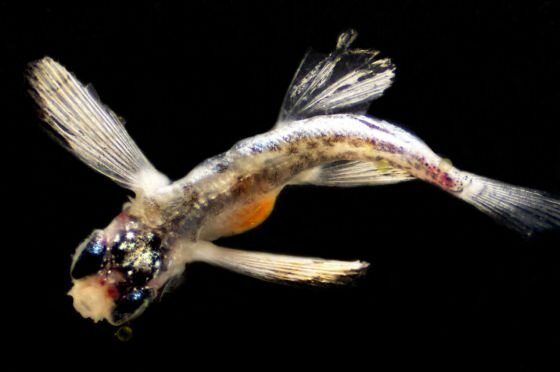
The data collected during the expedition's circumnavigation on board research vessels Hesperides and Sarmiento de Gamboa (between December 2010 and July 2011), scientists have concluded that previous estimates (based mainly on catches of trawling) biomass of these fish, about one billion tons, fall far short of reality as it could be around 10,000 million.
Xabier Irigoien , researcher at the University King Abdullah of Saudi Arabia , and colleagues , presented today in the journal Nature Communications their work and results obtained by analysis of data obtained during the expedition echosounder with computer models and show " that biomass mesopelagic fish in the open ocean is about one order of magnitude higher than previously estimated . " The records were taken between 40 degrees North and 40 degrees South latitude , from 200 to one thousand meters deep and day. These fish come out at night to the upper layers of the ocean to feed and return to the depths day to avoid predators .
" Malaspina has offered us a unique opportunity to assess the stock of mesopelagic fish in the ocean opportunity ," says Carlos Duarte, leader of the expedition . "So far our disposal only the data provided by trawling . Recently it has been discovered that these fish are able to detect network and run, which makes trawling in a biased tool when accounting for biomass , "the researcher said in a statement the Higher Council for Scientific Research ( CSIC).
Yorumlar()


İlgili Haberler
- Scottish scientists slow speed of light
- 'Rosetta' is evidence of 'Key of life'
- Lost Mars robot Beagle2 probe found 'intact' on red planet's surface
- DON'T MISS! Look Up to See Latest Comet Lovejoy
- Don't Miss: Quadrantids Meteor Shower peaks Saturday night,first of 2015
- Google presented the first fully functioning self-steering car
- The Curiosity rover photograph similar to the femur bone on Mars
- Astronomy: Any evidence of life on Mars likely in deep rock
- Skype Translator beta is released - and it could banish language barriers around the world
- Earth May Have Created Its Own Water Deep Within; And There's Still Enough There To Fill The Pacific
Son Eklenenler
- Scottish scientists slow speed of light
- 'Rosetta' is evidence of 'Key of life'
- Lost Mars robot Beagle2 probe found 'intact' on red planet's surface
- DON'T MISS! Look Up to See Latest Comet Lovejoy
- Don't Miss: Quadrantids Meteor Shower peaks Saturday night,first of 2015
- Google presented the first fully functioning self-steering car
- The Curiosity rover photograph similar to the femur bone on Mars
- Astronomy: Any evidence of life on Mars likely in deep rock
- Financial Conduct Authority consults on complaints handling improvements
- Skype Translator beta is released - and it could banish language barriers around the world
Çok Okunanlar
- Technology: Yahoo plans return to search engine projects 'Fast Break' and 'Curveball'
- New study confirms that: The male Y chromosome is retained
- How To Close Down Background Applications On iOS 7 For iPhone and iPad ? LEARN FROM WITH VIDEO!
- Epic Trolling News: Samsung pays Apple $1 Billion sending by 30 trucks filled with about 20 billion units of 5 cents coins for patent litigation.
- Scientists discover a huge reservoir of fresh water Under Greenland Ice Sheet
- The Crab Nebula has a noble gas molecules do not occur in space, NASA says
- WHAT DIFFERENCES TO SAMSUNG GALAXY S4 AND GALAXY S4 MINI, WHICH ONE DO YOU CHOOSE ?
- More fish in the darkness of the ocean 10 times more than previously thought
- New footage of Felix Baumgartner space jump will leave you gasping for air
- Hawking says: 'Black holes do not exist'